If you are an engaged couple in Ontario, and excited about your wedding, but a little unsure about what the future holds financially? You might have heard about prenups and wondered if they’re only for the rich or a sign of mistrust. In reality, a prenup is simply an effective way to protect your assets and set well-defined financial expectations before marriage.
This guide clears up common myths and explains what a prenuptial agreement in Ontario means so that you can start your marriage with confidence and peace of mind.
What Is a Prenup in Ontario?
In Ontario, what most people call a prenup is officially known as a marriage contract. It’s a legal agreement that two people sign before marriage to decide how their money, property, and debts will be managed if they ever separate, divorce, or one partner passes away.
Prenup is not about expecting a breakup. It’s about planning smartly and avoiding confusion later.
Instead of following the default rules under Ontario’s Family Law Act, a prenuptial agreement (prenup) allows couples to make a plan that fits their specific situation. It’s a smart way to sort out financial matters early, helping to prevent future misunderstandings, reduce conflicts, and maintain open and honest communication.
Ontario’s Family Law Act and Prenup
In Ontario, prenups are fully recognized under the Family Law Act (R.S.O. 1990, c. F.3). This is the main law that covers family and marriage-related matters in the province. The rules about these agreements are mainly found in Part IV, which talks about domestic contracts, including prenups or marriage contracts.
Under this law, couples can opt to establish their own financial guidelines instead of adhering to the default ones. For example, they can decide how to split property and assets (normally covered under Part I: Equalization of Net Family Property) or outline how spousal support will work (Part III).
A prenup works just like any other legal agreement. Both partners have to sign it voluntarily, fully understand what it means, and be honest about their finances. When done properly, it becomes legally binding and enforceable in Ontario courts.
In short, the Family Law Act gives couples the freedom to create a plan that suits their relationship, as long as it’s fair, transparent, and follows the basic legal principles.
What a Prenup Can and Can’t Cover
A prenup in Ontario can cover a lot of financial matters, but not everything. Let’s take a quick look at what’s allowed and what’s not.
What It Can Cover
- Property and Assets: You can decide how to divide things like houses, investments, pensions, or businesses if you ever separate.
- Debts: You can clarify who’s responsible for any debts brought into or created during the marriage.
- Spousal Support: You can agree on how much support (if any) will be paid and for how long.
- Inheritances and Gifts: You can protect inheritances or gifts from being shared as family property.
- Business Interests: You can protect ownership or income from a personal or family business.
- Matrimonial Home: You can agree on who will stay in the home or how it’ll be handled after separation.
Be completely honest about your finances. Both partners must disclose all details of their assets and debts, as concealing information can render the agreement invalid.
What It Can’t Cover
- Child Custody and Access: Courts always decide what’s best for the child at the time of separation.
- Child Support: Parents can’t skip or reduce child support through a contract, as it’s decided by law.
- Unfair or Forced Terms: If any part of the contract is unfair, misleading, or signed under pressure, the court can reject it.
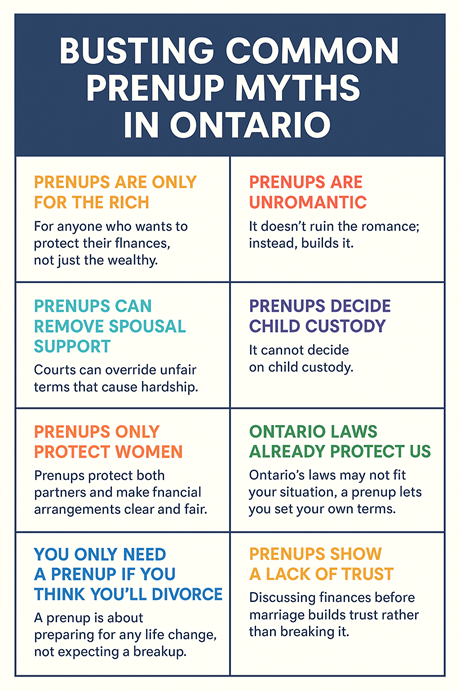
Common Myths About Prenups in Ontario
The term “prenup” still carries a negative connotation. Many people hear it and instantly think of drama, mistrust, or something only wealthy couples worry about. But that couldn’t be further from the truth.
In Ontario, prenuptial agreements are just smart planning tools that help couples start married life with clarity and confidence. So, let’s bust a few myths once and for all.
1. Prenups Are Only for the Rich
Prenups aren’t just for millionaires or celebrities. Whether you have a car loan, a small savings account, or a family cottage, a prenup can help you protect what’s yours. It’s about being transparent and fair, not about how much money you have.
2. Prenups Are Unromantic
Many people think talking about a prenup before marriage ruins the romance, but that’s not true. Romance isn’t just about flowers and fancy dinners. It’s also about building a future together where both of you feel secure and understood.
3. Prenups Can Remove Spousal Support
A prenup can include terms regarding spousal support, such as the amount one partner might pay, the duration, or even whether it will be waived completely. But Ontario courts will only respect those terms if they’re fair.
If a judge thinks the agreement would cause hardship. For instance, if one partner ends up struggling financially while the other is fine, the court can override that part of the prenup.
4. Prenups Decide Child Custody
Prenups cannot decide child custody or child support in Ontario or anywhere in Canada.
Child custody and support are always decided based on what’s best for the child, not what parents agreed to in a contract. Even if a prenup tries to include those terms, the court will ignore them.
You can plan your finances, property, and spousal support in a prenup, but when it comes to kids, the law always puts their needs first.
5. Prenups Only Protect Women
A prenup isn’t just for women; it’s for both partners. It helps ensure that everything is fair, regardless of whether one of you has more money, more debt, or owns a business.
It’s not about picking sides. It’s about being open and clear so that both people feel safe and protected, regardless of what happens later.
6. Ontario Laws Already Protect Us
Yes, Ontario’s Family Law Act does have rules for dividing property and support, but those are default rules. They might not suit your unique situation or what feels fair to you both. A prenup lets you create your own terms instead of leaving those decisions to the court later on.
7. You Only Need a Prenup if You Think You’ll Divorce
There’s a common misconception that your partner only signs a prenuptial agreement when he has a plan for a breakup. In reality, it’s more about being ready for life’s curveballs you might not see coming. Think of a prenup as a form of insurance: while you hope you never have to use it, it still provides protection in case of unexpected events, such as separation, illness, or even death.
8. Prenups Show a Lack of Trust
Actually, it’s quite the opposite. Talking about money and future plans before marriage builds trust, not breaks it. It shows maturity and honesty; two things every strong relationship needs. Many couples find that these conversations bring them even closer together.