

More and more Canadians are realizing that talking about money before marriage isn’t unromantic. Instead, it’s a wise and smart move with the consent of your partner. That’s why prenuptial agreements are becoming a popular search topic across the country. Still, bringing up a prenup can feel awkward. Many couples worry it might hurt their relationship or make it seem like they don’t trust each other.
Above all, there’s a lot of confusion: What exactly is a prenup? Does it even hold up in Canada? Why does every province seem to have its own rules? And why is the legal language so stressful? It’s no surprise Canadians keep turning to Google for answers.
Top 10 Questions Canadians Google About Prenups
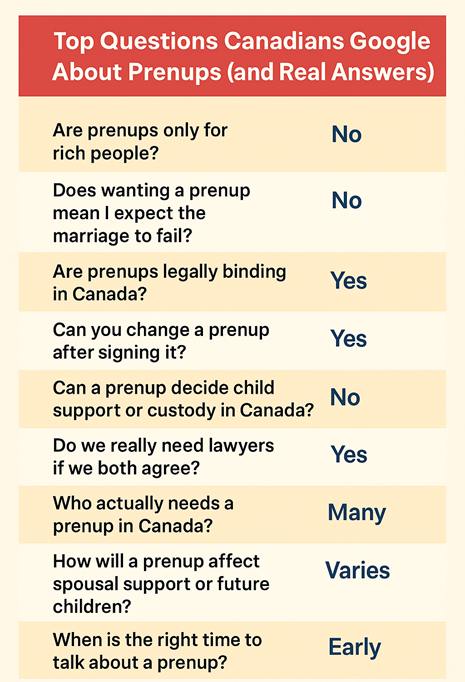
1. Are prenups only for wealthy people?
A lot of Canadians still assume prenups are something only celebrities or ultra-wealthy couples bother with. In reality, that couldn’t be further from the truth. Prenups in Canada are helpful for anyone who has something to protect, whether that’s a condo, some savings, a car, a business idea, or even debt.
A prenup creates clarity around what belongs to whom. Even if your current net worth is modest, having things clearly outlined can prevent confusion or disputes later. So yes, prenups matter at every income level, not just for the wealthy.
2. Does wanting a prenup mean I expect the marriage to fail?
This is one of the biggest emotional barriers Canadians face. Many people fear that even mentioning a prenup will look like a lack of trust. But a prenup is not a prediction of failure; it’s responsible planning.
Think of it like insurance or a financial safety plan. You hope you’ll never need it, but creating one actually helps reduce stress and uncertainty in your relationship. Couples who talk openly about money tend to communicate better and feel more secure together.
3. Do we really need lawyers if we both agree on everything?
Yes, without any doubt. For a prenup to be considered enforceable in Canada, each partner must get independent legal advice from their own lawyer. Lawyers ensure:
- Both partners fully understand the agreement
- There is no pressure or unfairness
- The contract follows provincial family law rules
Skipping this step greatly increases the chance that parts, or even the entire prenup, could be struck down later.
4. Are prenups legally binding in Canada?
Yes, Canadian prenups are legally binding, but only if done correctly. This means both partners must provide full financial disclosure, sign voluntarily, and most importantly, receive independent legal advice from separate lawyers.
If these steps are skipped, the agreement becomes much more vulnerable to challenge or reversal in court. A well-drafted prenup, with proper legal guidance, is taken seriously by Canadian courts and can hold up very well over time.
5. Can you change a prenup after signing it?
Absolutely. While prenups are designed to last, they’re not frozen forever. Couples can review and update the agreement later if major life events occur, such as having children, receiving an inheritance, relocating to another province or experiencing a major career change.
Updating a prenup ensures it stays fair and relevant as your life evolves. Many couples treat it like reviewing insurance or updating a will, something you revisit periodically to keep things current.
6. Can a prenup decide child support or custody in Canada?
No, child-related matters are entirely off the table in a prenup. Canadian law is very clear about this: anything involving child support or custody must always be decided at the time of separation, based on what is in the best interests of the child.
Parents cannot waive child support in advance, nor can they predetermine custody arrangements. This protects children’s rights and ensures they receive proper support regardless of any prior agreements between their parents.
7. Who actually needs a prenup in Canada?
Many Canadians Google this when trying to figure out whether a prenup fits their situation. Below are some of the most common reasons you should consider:
- You own property, investments or a business
- You have personal debts you don’t want shared
- You expect an inheritance or financial gifts
- You’re entering a second marriage or blending families
- You and your partner have very different income levels or financial habits
- You and your partner want to talk about and make a plan togehter
If any of these apply to you, a prenup can offer protection, clarity and peace of mind.
8. How will a prenup affect spousal support or future children?
This is another major concern couples research.
Spousal Support
A prenup can outline expectations for spousal support, but Canadian courts still have the power to override parts of the agreement if it becomes unfair over time. For example, major life changes like one partner pausing their career to raise children, can influence how courts treat spousal support clauses.
Future Children
While a prenup cannot decide child support or custody, it can still help set financial expectations around property and spousal support if children are born later. Courts consistently rely on the Department of Justice Canada guidelines and provincial family laws to make the final decisions.
9. When is the right time to talk about a prenup?
Many Canadians search for the ‘best timing,’ and the simplest advice is to start early. Bringing it up well before the wedding avoids:
- pressure
- rushed decisions
- emotional stress
- last-minute legal complications
Early conversations show maturity and allow both partners time to speak with lawyers, gather financial information, and think through the details calmly.
10. How do we know if we’re ready for a prenup?
Couples often feel unsure about whether they’re prepared for the prenup process. A quick self-check can help you gauge your readiness. Ask yourselves:
- Do we talk openly and honestly about money?
- Do we understand the basics of family law in our province?
- Have we discussed future plans like children, career changes or buying property?
- Are we both comfortable sharing full financial details?
- Are we prepared to speak with separate lawyers?
If you find yourselves answering “yes” to most of these, you’re in a strong position to start the prenup process confidently.