

If you’re a resident of Ontario and you’re in a relationship, married, or planning to get married, you might be thinking about making some kind of agreement with your partner. But you may feel confused about which type of agreement to choose. There are several options, such as a marriage contract (which includes a prenup or postnup) or a cohabitation agreement, so your confusion is completely understandable.
In Ontario, terms like marriage contract, cohabitation agreement, and prenup often get mixed up, leaving couples unsure about what they actually need.
So, in this article, we’ll do our best to give you a clear understanding of the different types of relationship agreements, so it becomes easier for you to decide which one is right for you.
What Is a Marriage Contract? (Prenup and Postnup)
A Marriage Contract is basically Ontario’s version of a prenup. It’s a legal agreement that couples can make before or after getting married to sort out financial matters. It clearly sets out who owns what, how assets or debts will be divided if you ever separate, and whether either partner will pay spousal support.
Under Section 52 of Ontario’s Family Law Act, couples can use a Marriage Contract to define their own property rights and financial responsibilities even if it means changing what the law would normally say.
In simple terms, it’s for anyone who’s about to get married or is already married and wants to make sure both partners are on the same page about money. You can include things like property division, support terms, and inheritance rights, but not child custody or child support.
Even though people often call it a prenup, the correct legal term in Ontario is Marriage Contract. It gives peace of mind, reduces future money arguments, and protects any assets or inheritance you had before marriage.
What Is a Cohabitation Agreement?
A Cohabitation Agreement is like a prenup but for couples who aren’t married. It’s a legal contract for people who live together (or plan to) and want to define how money, property, and responsibilities will be handled if they break up or if one partner passes away.
This type of agreement is covered under Section 53 of Ontario’s Family Law Act and works almost the same way as a Marriage Contract, except it’s designed for common-law couples.
It’s perfect for couples who share a home but want their finances clear. You can decide how to split the property. You can also handle shared debts and manage living expenses.
If a couple with a Cohabitation Agreement later gets married, that agreement automatically becomes a Marriage Contract, unless the document says otherwise.
In short, a Cohabitation Agreement helps avoid legal confusion later. It gives both partners financial security and keeps things fair and transparent, even without a marriage certificate.
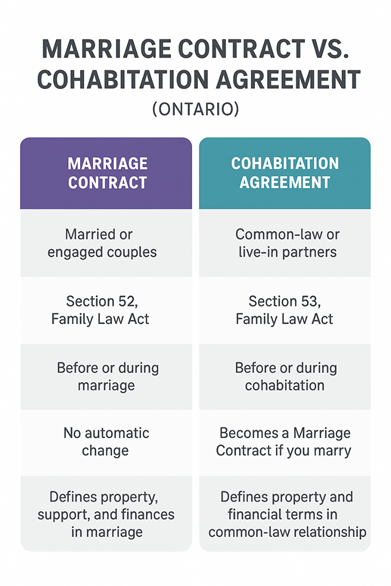
The 7 Key Differences b/w Marriage Contract & Cohabitation Agreement in Ontario
1. Relationship Type
A Marriage Contract, known as a prenup or postnup, is designed for couples who are either already married or planning to get married. On the other hand, a Cohabitation Agreement applies to couples who are living together in a common-law relationship or intend to move in together without marrying.
2. Legal Basis
In Ontario, Marriage Contracts are governed by Section 52 of the Family Law Act, while Cohabitation Agreements fall under Section 53 of the same Act. Both serve to outline financial and property arrangements, but apply to different types of relationships.
3. Timing
A Marriage Contract can be endorsed either before the wedding as a prenuptial agreement or after the marriage as a postnuptial agreement. In contrast, a Cohabitation Agreement can be entered into before or during cohabitation, giving couples flexibility to set terms at any stage of their relationship.
4. Automatic Conversion
A Marriage Contract remains valid only within the context of marriage and does not change into another type of agreement. However, a Cohabitation Agreement automatically converts into a Marriage Contract if both partners later decide to marry, unless the agreement explicitly states otherwise.
5. Legal Effect
Both agreements are legally binding and address similar issues, but within their respective relationship contexts. A Marriage Contract covers property division, spousal support, and financial responsibilities during or after marriage. Similarly, a Cohabitation Agreement outlines property division, support obligations, and financial arrangements during or after cohabitation.
6. Property Rights
A Marriage Contract can override Ontario’s default property division rules, letting couples decide how assets are shared if they separate. While Cohabitation Agreements are vital for common-law partners, who lack automatic property rights. These agreements define property ownership and division in advance.
7. Purpose
Both agreements serve a preventive and clarifying purpose. A Marriage Contract helps protect assets, define financial expectations, and avoid disputes between spouses. Similarly, a Cohabitation Agreement ensures financial clarity and asset protection between partners who live together but are not legally married.
When to Consider Each Agreement
Before Marriage (Prenup)
A marriage contract, often called a prenup, is a smart idea before tying the knot if:
- One or both of you already own valuable assets like a house, investments, or a business that you want to protect.
- You expect to receive a big inheritance in the future.
- One or both of you have children from a previous relationship and want to make sure their inheritance is secure.
- You and your partner have very different levels of income or debt.
After Marriage (Postnup)
Even if you didn’t sign a prenup before getting married, you can still create one later, called a postnup. It’s useful when:
- Your financial situation changes, like starting a business or receiving an inheritance.
- You’ve been married for a while and want to clearly define your financial responsibilities, or what will happen if things change later.
When a Cohabitation Agreement Makes Sense
If you’re not married but share a home, a cohabitation agreement can help clarify financial expectations. It’s especially useful if:
- You’re planning to move in together and want to decide who pays what and who owns what.
- You’ve already been living together for a while and want to make things official in writing.
- One partner is putting in a lot more money. For example, paying most of the bills or buying the house.
- One of you has kids from a previous relationship and wants to protect their inheritance or assets.