

Polyamorous relationships are becoming more common, and many people are building loving families with more than one partner. But while love grows, the law often lags behind. This can leave people feeling unsure about money, property and long-term security.
In polyamorous families, partners can face risks like uneven asset protection, unclear inheritance rights or financial stress for someone who is not legally married. Talking about these issues can also feel overwhelming without proper guidance.
We’ll help you in this guide to remove that stress. We’ll explain important legal tools in simple terms and give practical steps you can use right away. The goal is to help every partner feel safe, respected and supported. With the proper planning, your polyamorous relationships can stay strong, fair and secure for everyone involved.
Understanding the Current Legal Landscape for Polyamorous Relationships
Marriage and Domestic Partnerships
Legal marriage is built around two people in most places. This creates problems for people in polyamorous relationships. A common example is a hinge partner who can marry one partner but not the others. Many provinces offer domestic partnerships or civil unions, but these options usually cover only two people. The rules also change from province to province, so you must check your local laws.
Common Law Marriage
Some provinces recognize common law “marriage”. It has specific conditions, such as living together for a certain period and presenting yourselves as a married couple. This system is already hard to prove for two people. It becomes even more complicated for more than two partners. You must consult reliable legal sources to determine whether your province recognizes common law marriage.
Recognition Gaps and Legal Risks
Many laws do not protect partners who are not legally married. This leaves many polyamorous families exposed to real problems. Common issues include no automatic inheritance rights, no authority to make medical decisions and confusion over how to divide property. The safest approach is to familiarize yourself with your province’s laws thoroughly. Every province handles these situations differently.
How Prenups Can Be Used in Polyamorous Relationships?
A traditional prenup can only protect the married partners in a polycule. It cannot cover or legally include other partners. Still, the ideas behind a prenup can help set clear money rules in a polyamorous family. It can define boundaries, expectations and financial roles in relation to other partners.
Polyamorous families who want more protection can create custom agreements. These documents can be designed to fit their unique structures and help avoid confusion. Creativity and careful planning are important, as the law is still limited in many areas.
Relationship Scenario Matrix and Legal Implications
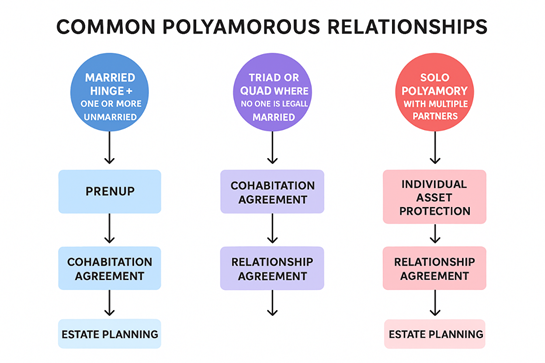
Polyamorous families come in many shapes. Each structure has its own legal and financial needs. Below are common scenarios and the type of planning that usually helps.
Scenario 1: A Married Hinge with One or More Unmarried Partners
In this setup, one partner is legally married, and the others are not.
For the married couple, a prenup can protect both partners and help keep their finances organized. It can also explain how assets will be handled if the marriage ends.
Unmarried partners need other tools. Cohabitation agreements, relationship agreements and proper estate planning can offer protection. These documents help define financial roles, shared expenses and long-term expectations.
This structure can get complicated when money overlaps. Clear rules for how to combine or separate finances can prevent conflict later.
Scenario 2: A Triad or Quad with No Legal Marriage
In this structure, no one is legally married, but all partners share a relationship. A cohabitation agreement is one of the strongest tools for this group, especially if everyone lives together. It can outline how bills, debts and shared expenses are handled. A relationship agreement also supports communication and clarity.
If the group owns property, it must choose how to hold the title. Options like tenants in common or joint tenancy affect what happens if someone leaves or passes away.
Estate planning is crucial. It ensures that each partner can receive inheritances and remain protected.
Scenario 3: Solo Polyamory with Multiple Partners
Here, one person has several partners but does not live with them.
The primary focus is personal asset protection. Each partner may have different levels of involvement, so it is helpful to keep finances separate. Relationship agreements can set expectations without needing a shared home. These documents help define emotional roles, time commitments and boundaries.
Estate planning is still important. It lets you provide for multiple partners and ensure your wishes are carried out.
Financial and Estate Planning in Polyamory
Understanding Your Money as a Group
In polyamory, money conversations matter a lot. Every partner should know what belongs to them and what is shared. It helps to talk openly about personal assets and shared assets. Some people like to keep their finances separate. Others choose to combine certain things while keeping the rest private. The goal is to stay independent but still support each other healthily.
You can use simple financial worksheets or budgeting tools to map out who owns what, who owes what, and what you want to handle together.
Managing Debts and Monthly Costs
If you share a home or bills, you will need a clear system for handling them. It might be equal for everyone or based on income. What matters most is transparency. Everyone should know their part and feel comfortable with it.
Debts also need attention. Shared debts, such as a mortgage or a joint credit card, require clear rules. Personal debts should stay personal, so no one feels responsible for what they did not create.
Financial Support in Different Situations
Support can look different in polyamorous setups. Married partners may address spousal support later. Non-married partners might still agree to help each other during tough times, such as illness or job changes. These arrangements may not be legal contracts, but they help set expectations and avoid misunderstandings.
A simple tip is to write down how you want to handle both assets and debts. It keeps the whole group on the same page.
Relationship Agreements and Expectations
Why a Written Relationship Agreement Helps?
Money is only one part of planning. Many polyamorous groups also create a written relationship agreement. It includes things like communication habits, emotional needs, parenting roles and personal boundaries. It is not a legal document, but it brings clarity. It also helps during conflicts because everyone can look back at what they agreed on.
Talking About Hard Topics
Sensitive conversations are normal. You can make them easier with gentle language. Use a simple format like “I feel… when… because… I need…” to express your feelings. This helps everyone stay calm and honest.
A mediator can also help if you want support while discussing rules or agreements. It is useful when emotions are high or when many people are involved.
Setting Boundaries and Shared Expectations
Healthy polyamory needs clear boundaries. It helps to talk about what commitment means for each person. You can also discuss time management, emotional limits and how you plan to introduce new partners. These talks help everyone feel respected and informed.
Estate Planning Essentials for Polyamorous Families
Wills and Trusts for Your Family Setup
Estate planning is very important for polyamorous families. A will helps you clearly province who should receive your assets and who you want to protect. This is especially important when some partners are not legally recognized by the province.
Trusts can also help. A living trust or a trust created after death can support partners and children who are outside traditional marriage laws. These tools make sure everyone you care about is included and supported.
A simple tip is to take estate planning seriously. Wills, trusts, medical directives and powers of attorney are key for partners who are not legally married.
Updating Beneficiary Information
Beneficiary designations are often ignored, but they matter a lot. You should update the beneficiaries on your life insurance, retirement accounts and bank accounts. These designations usually override what is written in a will. So if you forget to update them, your assets may go to someone you did not intend.
Powers of Attorney for Medical and Financial Decisions
- A financial power of attorney lets a trusted partner handle your finances if you cannot.
- Medical power of attorney allows a partner to make health decisions for you.
- Prevents issues like hospital visitation being denied.
Real cases show that partners without medical documents are sometimes kept out of hospital rooms. These agreements prevent that.
Planning Guardianship for Children
If you have children in a polyamorous family, you should plan who will take care of them if something happens. This is important when not all parents are legally married or legally recognized. A clear guardianship plan protects the children and avoids family conflict.
You can also use simple estate planning checklists made for non-traditional families to stay organized.